Last week I had the privilege of being part of the panel for HakITxMRDU @ the Malla Reddy (MR) Deemed to be University.
It was an interesting panel group. We had one member who focuses on deep technical training. Another who connects people looking for opportunities with people looking for talent. Another was a founder who builds specialised software products for customers. One who creates impact for people. One who is deeply passionate about bringing free education to all. And finally me, who focuses on converting learned skills into applied experience.
Thanks to PSNM Innovations for recommending me for this panel discussion at the Malla Reddy tech fest.
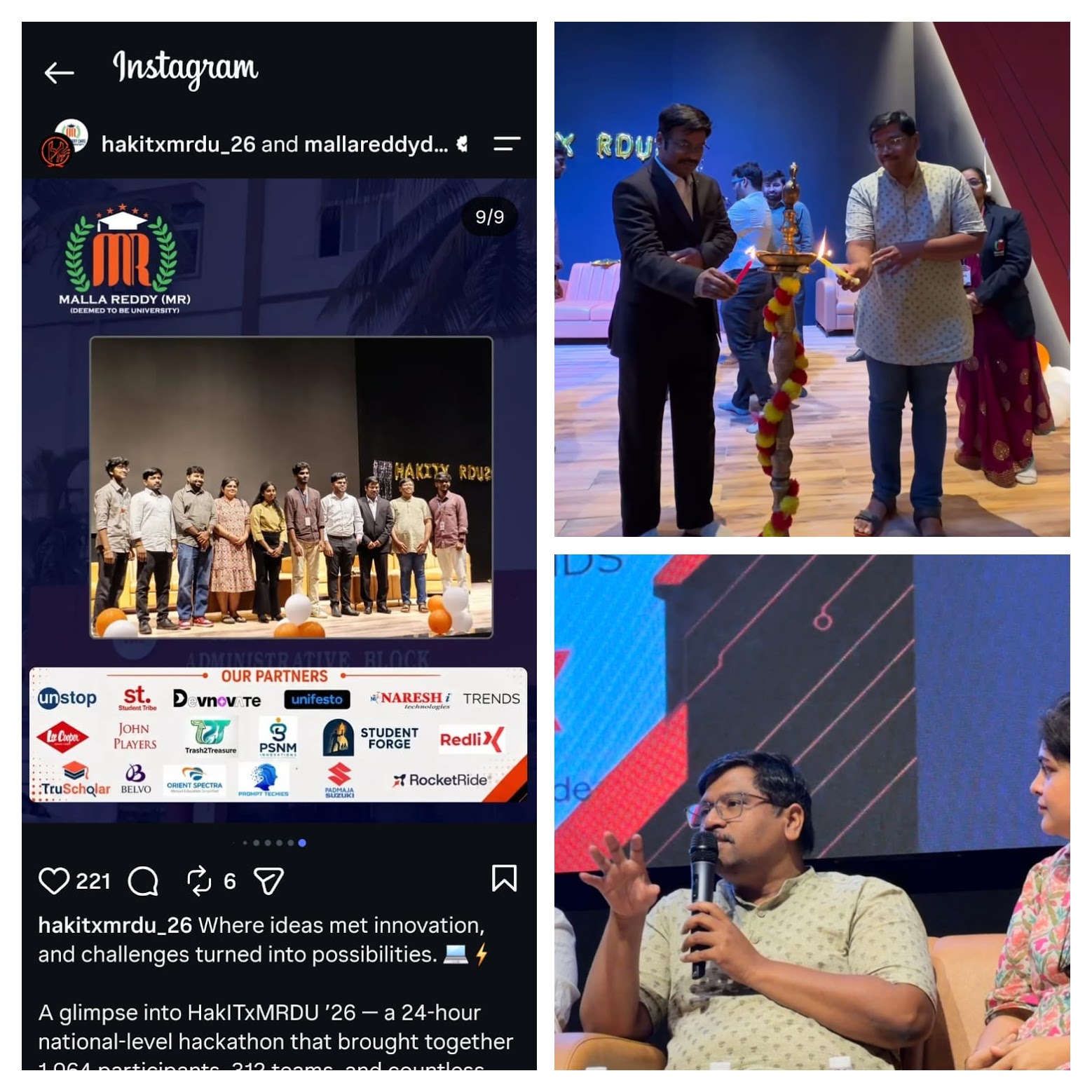
Almost 1000+ students attended the panel discussion. The questions posed to us were varied too. I may have to write a couple more blogs to cover all of them.
In this one, I will talk about the first question we got:
"When you get a resume, what will you look for in it to decide to drop it or move it forward?"
The obsession problem
I see some students obsessed with their resume. They spend too much time writing and re-writing it.
I feel this is hyped. Your resume is just a record of what YOU have done so far, which makes you believe you would be a good fit for a particular job. It is not a novel or a movie story you have to create.
If you drop the obsession, I do have some recommendations to make the resume stand out and move forward. But before we jump into them, it is worth taking a step back to understand how the system works, and where the resume actually fits into it.
How the hiring pipeline actually works
The process and scale differ based on the size of the company. How a small startup hires is going to be different from how a large MNC hires. How an on-campus drive happens will be different from an off-campus drive.
But the shape is roughly the same.
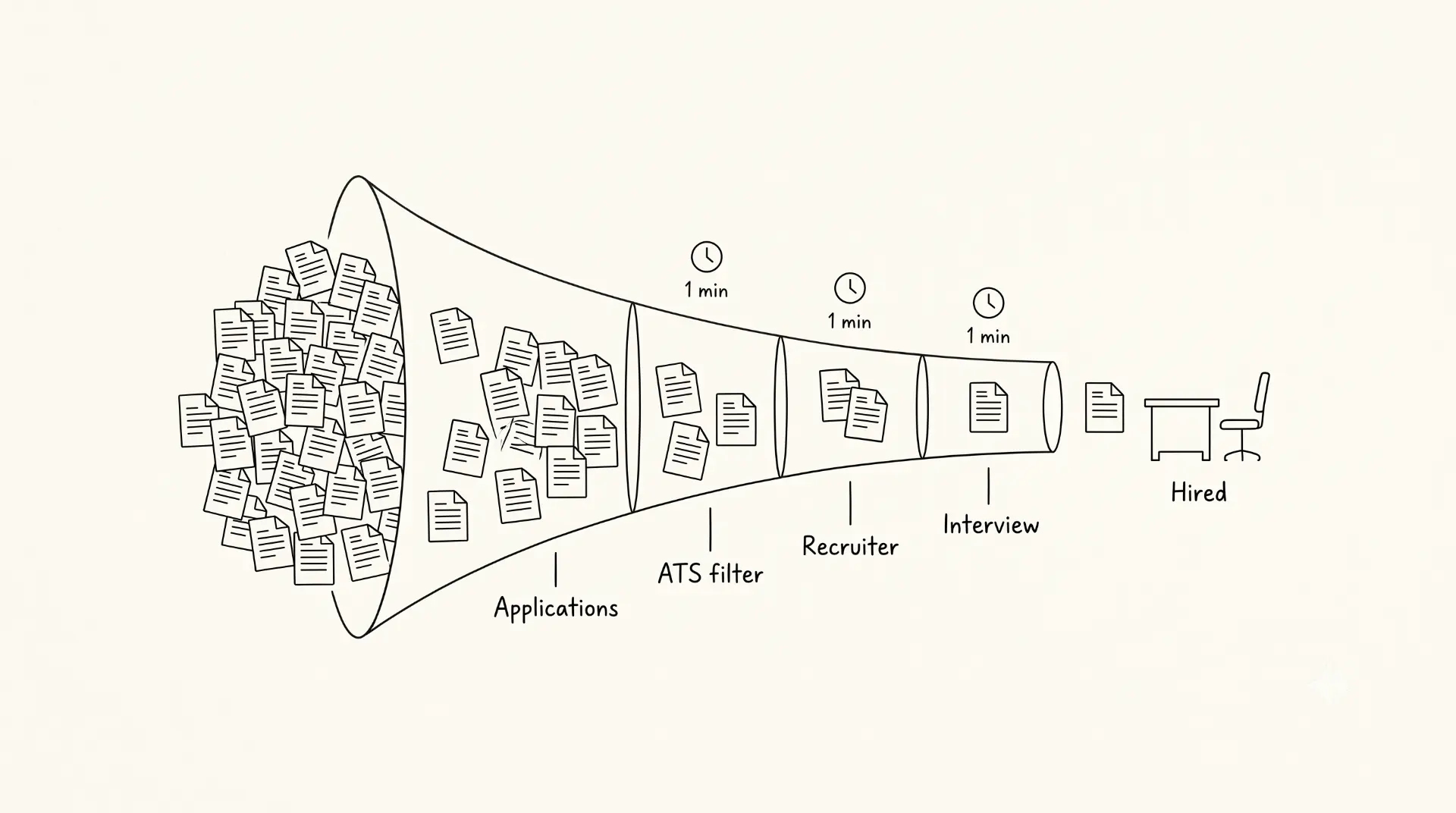
Step 1 - Collecting resumes. A typical hiring process starts by gathering potential candidate resumes from various sources: online applications, outreach by recruiters, employee referrals.
This part of the pipeline has become very noisy. The ratio of openings to applicants has become impractical, for multiple reasons that are beyond anyone's control.
Step 2 - The ATS filter. This noise created a new problem for both candidates and recruiters. So automated solutions came in - the ATS, or Applicant Tracking System - to help recruiters comb through all the applications and shortlist a few.
Note this carefully. So far, no human has looked at your resume.
Step 3 - The recruiter glance. The recruiter glances at your resume - remember, just glances, maybe a minute at most - to decide whether to move it forward and schedule a call. This is partly due to the sheer volume, and partly because of the experience they have built doing resume filtering.
Your resume has now been looked at for one minute.
Step 4 - The interviewer. Say the interview gets scheduled. The interviewer most likely opens your resume for a minute just before walking into the interview.
Your resume has now been looked at for another minute.
Step 5 - The hiring manager round. If you clear the technical rounds, someone looks at the human side of your profile. This is the longest look your resume gets, and it is still only for another minute.
In total, your resume is looked at by someone relevant for not more than 5 minutes. Let that sink in.
Once you understand that, the recommendations make sense
Every recommendation below comes from one simple fact - you are optimising for three different readers, and each of them has very little time.
For the ATS and the recruiter
They are not experts in your domain. The bot is matching keywords. The recruiter is scanning.
So keep the formatting simple. Keep the text and keywords brief. Do not use fancy templates. Plain and scannable beats pretty.
Note: For campus placements, stick to the template provided by your collage.
For the interviewer
Human interviewers look for similarities between your background and the projects they are currently working on, or have recently finished. They use this to frame the questions they will ask you.
Two things I would suggest here.
First, only include project details you are confident explaining - specifically your individual contribution. Not what the team did. What you did. If you cannot defend a line, remove that line.
Second, add a slight surprise or variation somewhere. Something a little different from every other resume in that stack. It buys you a few extra seconds of attention, and it often becomes the question they open with.
For the hiring manager
This round looks for the human aspects - passion, authenticity, reasoning, curiosity. Some people call it culture fit.
Keep it as authentic and genuine as possible, so that you are confident while talking about it. Ideally you should feel proud, and ready to brag a little about these points.
This also does not have to be limited to technical skills. Include a hobby or a passion. It shows who you are, and it gives the conversation somewhere to go.
Take away from this
Your resume is not the thing that gets you the job. It is the thing that gets you into the room.
So build the work first. Then write it down plainly, in a way that survives a bot, a glance, and a conversation.
That is 5 minutes of attention. Spend your remaining time building something worth putting in it !
Follow along on WhatsApp for more such posts - join the channel.
#KeepLearning #GrowTogether