Recently a student came to me with a concern. He was not getting a job.
I strongly believe I should not be the one solving it for him. What I can do is share a thought process, so that he can find the answer himself. In this post, I am sharing that same technique with you, and I would encourage you to give it a shot.
Where I picked this up
I learnt this simple technique during my time at Microsoft and used it a lot while handling service and production oncall for our team.
In the industry, it is popularly used to do Root Cause Analysis (RCA) of service and production incidents. You can read how some of the big teams talk about it:
- AWS Well-Architected - Five Whys
- Microsoft Azure - Root cause analysis
- Google SRE Workbook - Incident response
Over time, I found it is a simple and versatile technique that works for many other problems too, not just production incidents.
What is "5 Whys"
The technique is called "5 Whys". It was originally pioneered at Toyota (Wikipedia).
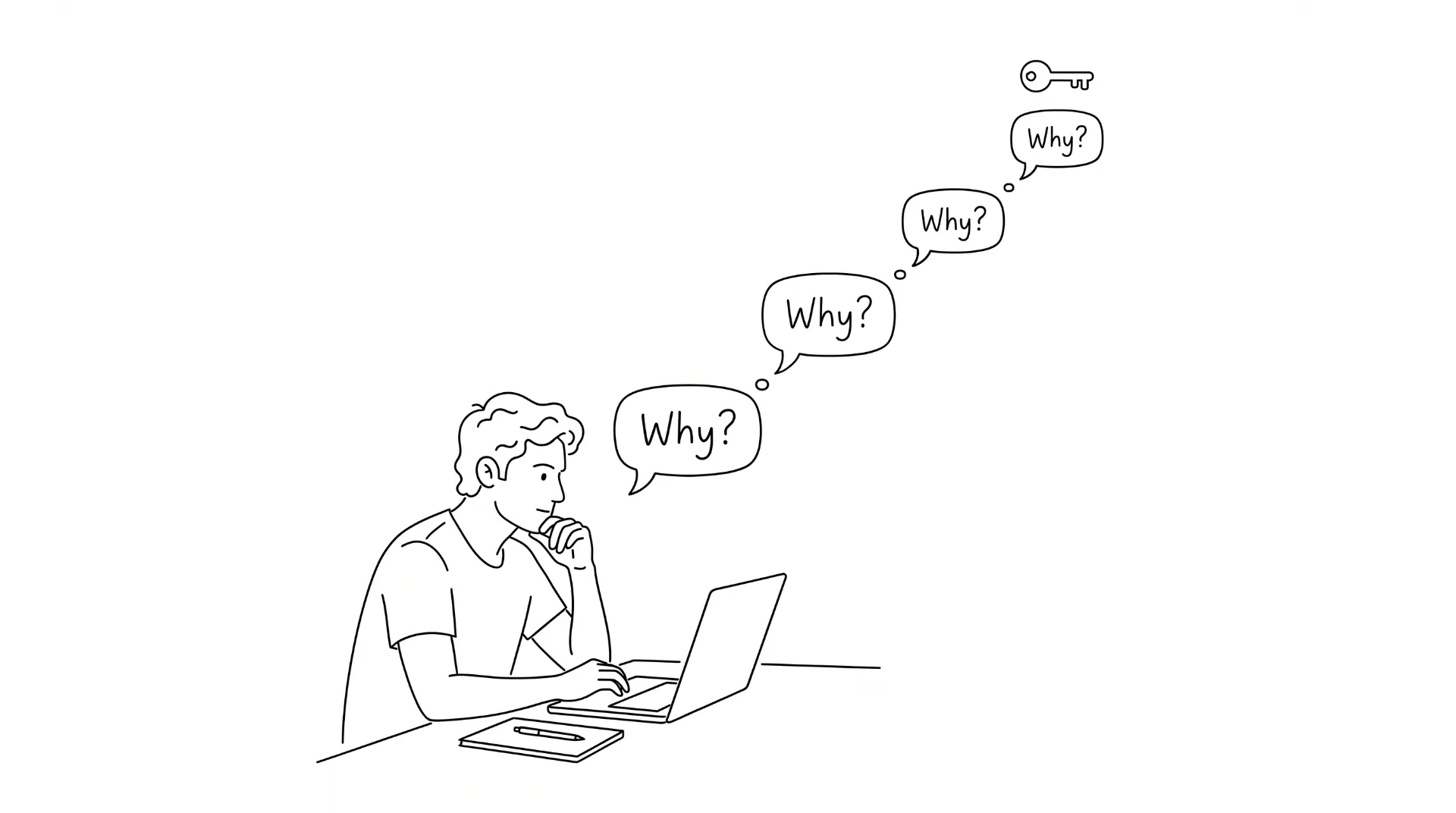
It is an iterative approach to find the root cause of a problem. You ask "why", get an answer, and then ask "why" again on that answer. Each new "why" goes after the answer to the previous one.
It is popularly called 5 Whys, but of course the number of whys can be more or less :-)
Let's see it in action
Here is a simple example. I ordered a T-shirt online and received a different size from what I ordered. I raised it with the support team, and they resolved it quickly by sending me a free replacement.
But a good company does not stop there. It takes such a support ticket as an opportunity to understand why it happened and how to avoid it in future.
- Why did the customer receive the wrong size T-shirt?
The packaging team packed it wrongly. - Why did the packaging team pack it wrongly?
The refilling team put one size of shirt in the rack of another size. - Why did the refilling team put it in the wrong rack?
They used the sticker on the package to decide the rack. - Why did the T-shirt get the wrong sticker?
There was a typo in one of the stickers. - Root cause: A typo in one of the stickers. Ask the DTP team to proofread the stickers and update them.
It can go on further, but you get the point. The deeper you go, the better you understand the real root cause that needs to be addressed. Otherwise you end up fixing the wrong thing and wasting your time.
One honest note
As you can see, the technique itself is very basic. It does not give you a solution on its own. It works only if you are honest while answering each "why".
So take your job or internship hunt, write down the problem, and start asking why. All the best with debugging your job/internship hunt!
Follow along on WhatsApp for more such posts.
#KeepLearning #GrowTogether